Tag: Trust

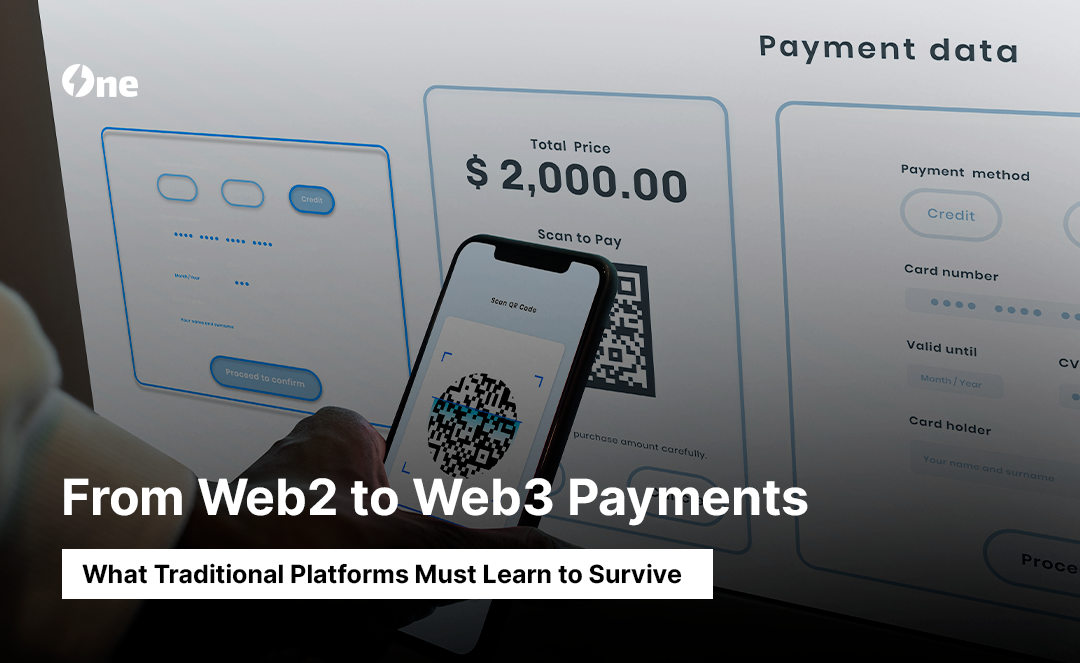
  • From Web2 to Web3 Payments: What Traditional Platforms Must Learn to Survive

    From Web2 to Web3 Payments: What Traditional Platforms Must Learn to Survive

    For two decades, Web2 platforms such as e-commerce, SaaS, and online marketplaces, have powered the global digital economy.

    Through the years, they have perfected user interfaces, optimized conversion funnels, and scaled to billions of customers.

    But beneath that success lies an aging foundation: payment infrastructure built for another era.

    Slow settlements, high fees, regional limitations, and fragmented data models have become the hidden tax of doing digital business.

    And now, Web3 is exposing that inefficiency at scale.

    The next decade won’t be defined by better front-end experiences, but by smarter, faster back-end money movement.


    The Web2 Payments Paradox

    Web2 payments excel at accessibility but not efficiency.

    Behind the scenes, every “instant” checkout hides a maze of intermediaries: card processors, acquiring banks, networks, and clearinghouses.

    Each layer adds latency, cost, and risk.

    ProcessWeb2 ModelWeb3 Model
    Transaction Cost2-3%0.3-0.5%
    Settlement Time2-5 daysSeconds
    Cross-BorderRestricted by regionBorderless
    Data FlowFragmented across PSPsUnified & transparent

    For years, this inefficiency was tolerable.

    But as Web3-native businesses scale with lower overhead and instant settlement, traditional platforms are losing their advantage.

    The Web2 model wasn’t built to move at blockchain speed.

    What Web3 Gets Right

    Web3 platforms built on blockchain rails are rewriting the rules of commerce:

    • Instant global payments using stablecoins and on-chain transfers
    • Self-executing smart contracts that remove manual reconciliation
    • Interoperable wallets replacing siloed payment accounts
    • Programmable value enabling automated subscriptions, royalties, and payouts

    The result: faster transactions, higher margins, and better user retention.

    For traditional platforms, this is both a warning and an invitation.

    Why Legacy Systems Are Struggling to Adapt

    It’s not that legacy payment providers don’t understand blockchain, it’s that their architecture was never designed for it.

    Their systems rely on batch-based settlement cycles and closed data models.

    Blockchain, by contrast, is real-time and composable.

    This mismatch means legacy platforms face:

    • Complex integrations with emerging crypto rails
    • Higher operational overhead for compliance and reconciliation
    • Limited ability to scale globally with instant liquidity

    To stay competitive, traditional platforms must evolve from “payment processors” to “value networks.”

    Lessons from Web3 for Web2 Leaders

    Here’s what traditional payment and platform leaders can learn from Web3’s playbook:

    1️⃣ Speed Is Strategy

    • If you can move money faster, you can move markets faster.
    • Settlement speed now defines business agility.

    2️⃣ Cost Efficiency Scales Profitability

    • Every saved percentage point in fees compounds into millions in retained revenue.
    • Blockchain isn’t cost-cutting, it’s profit engineering.

    3️⃣ Interoperability Drives Growth

    • Closed networks create friction; open networks create ecosystems.
    • Web3 thrives because it’s built for connection, not control.

    4️⃣ Transparency Builds Trust

    • Users don’t just want convenience, they want clarity.
    • Blockchain gives both through verifiable, immutable data.

    Web2 platforms that embrace these lessons won’t just survive, they’ll lead the next financial evolution.

    The Bridge: AIO and the Hybrid Payment Model

    Transitioning from Web2 to Web3 doesn’t mean abandoning existing systems.

    It means bridging them.

    Why It Matters:

    • Plug & Play Integration: Works alongside legacy PSPs through APIs and webhooks.
    • Batch Transfers: Reduce gas costs by up to 90%.
    • Multi-Chain Compatibility: Support for EVM, TRON, BTC, and LTC.
    • Unified Reporting: Real-time analytics across on- and off-chain transactions.

    It’s the infrastructure that lets traditional platforms evolve without disruption.

    That’s the philosophy behind AIO, a blockchain payment platform built for traditional enterprises seeking modern efficiency.

    The Web2-to-Web3 Playbook for Executives

    Leaders who successfully navigate this transition will focus on four key actions:

    1. Integrate, Don’t Replace: Add blockchain rails alongside existing payment systems.
    2. Prioritize Liquidity: Faster settlement equals stronger working capital.
    3. Design for Transparency: Make payment data auditable and accessible.
    4. Future-Proof Your Stack: Choose partners and APIs that evolve with the ecosystem.

    These aren’t IT upgrades, they’re strategic imperatives.

    Why This Shift Is Inevitable

    Every major innovation in payments has followed the same pattern:

    Cash → Cards → Digital → Mobile → Blockchain.

    The curve is exponential, not optional.

    By 2030, analysts predict that over 60% of global B2B and B2C payments will be processed through blockchain-based networks.

    The companies adapting now are setting themselves up to lead that future.

    History rewards those who build for what’s coming, not for what’s currently comfortable.

    The Executive Takeaway

    Web3 isn’t replacing Web2, it’s revealing what comes next.

    The future belongs to platforms that treat payments not as a backend function, but as a strategic growth engine.

    The next era of commerce won’t be about clicks, it’ll be about transfers.

    AIO gives Web2 platforms the rails, reach, and readiness to evolve into Web3-native ecosystems.

    Ensure your business’ evolution for the next generation of payments with AIO.
  • Decentralized Trust: The Leadership Mindset for the Next Financial Decade

    Decentralized Trust: The Leadership Mindset for the Next Financial Decade

    For centuries, global finance has revolved around a single idea: trust is centralized.

    We’ve trusted banks to hold our money, regulators to secure our markets, and intermediaries to ensure fairness.

    But in 2025, that paradigm is shifting not because trust is vanishing, but because it’s being rebuilt into the network itself.

    Welcome to the age of decentralized trust where confidence doesn’t depend on an institution’s reputation, but on the transparency of its infrastructure.


    The Trust Crisis That Rewired Finance

    From the 2008 financial crash to the 2023 banking liquidity scare, every major disruption in modern finance has shared a common root: opacity.

    When systems are too complex to audit and too centralized to fail, they inevitably do.

    Blockchain emerged as a direct response not as rebellion, but as redesign.

    It proposed a world where trust isn’t granted, it’s verified.

    The next era of leadership isn’t about controlling trust, it’s about enabling it.

    From Institutional Trust to Infrastructure Trust

    Traditional finance runs on trusted intermediaries: banks, clearinghouses, payment processors, etc.

    Decentralized finance runs on trusted infrastructure: code, consensus, and transparency.

    The shift is subtle but profound:

    In decentralized systems, you don’t need to believe in the middleman.

    You can see the process yourself.

    Every transaction, every rule, every contract is publicly verifiable.

    This transforms trust from a human assumption into a mathematical guarantee.

    Why Leadership Must Evolve Alongside Technology

    Decentralized trust requires decentralized leadership.

    The C-level mindset that thrives in this era looks different:

    • It values transparency over hierarchy.
    • It leads through ecosystem collaboration, not isolation.
    • It builds systems that outlast individuals.

    Executives who embrace this shift aren’t giving up control, they’re gaining resilience.

    Because in decentralized systems, trust doesn’t fail when one actor does.

    The Business Advantage of Trust at Scale

    Trust is not a soft concept, it’s a hard business asset.

    McKinsey’s 2025 Trust in Finance study found that companies perceived as “trust-transparent” outperform peers by up to 40% in market valuation.

    That’s because transparency doesn’t just attract investors, it accelerates decision-making, reduces friction, and strengthens relationships with customers and partners.

    Blockchain makes that scalability of trust operational.

    Through smart contracts, every agreement becomes self-executing.

    Through distributed ledgers, every transaction becomes self-verifying.

    This is what AIO calls programmable trust.

    The Role of Blockchain in Trust Reinvention

    Blockchain doesn’t just digitize finance, it redefines accountability.

    In traditional systems, oversight happens after the fact through audits and reports.

    In blockchain systems, it happens in real time through visible, immutable data.

    The Result:

    • No hidden intermediaries
    • No delayed reconciliations
    • No trust gap between sender and receiver

    Transparency isn’t an option. It’s a feature.

    And that makes blockchain not just a financial tool but a leadership framework.

    Decentralized Leadership in Action

    Forward-thinking enterprises are already applying decentralized principles in how they build, partner, and govern:

    • Shared Infrastructure: Competing firms co-develop blockchain standards to expand the market together.
    • Smart Accountability: Automated compliance replaces manual reporting.
    • Collaborative Growth: Platforms build ecosystems, not monopolies.

    These are not just technology decisions, they’re leadership philosophies in practice.

    Decentralization doesn’t remove responsibility, it distributes it more intelligently.

    AIO: Enabling Trust Through Technology

    At its core, AIO exists to make decentralized trust work for business.

    Through its blockchain payment infrastructure, it enables enterprises to:

    • Operate transparently across global markets
    • Automate transactions and settlements
    • Prove integrity without adding complexity

    The result is trust that scales with technology: secure, verifiable, and built into every layer of the transaction network.

    The Executive Takeaway

    In the next decade, leadership will be defined not by how much control you hold but by how much trust your systems inspire.

    Blockchain isn’t just changing what finance looks like.

    It’s changing what leadership feels like.

    The best leaders don’t demand trust, they design it.

    AIO empowers enterprises to lead in that design where transparency becomes strength, and trust becomes infrastructure.

    Lead the charge to the future with AIO.